
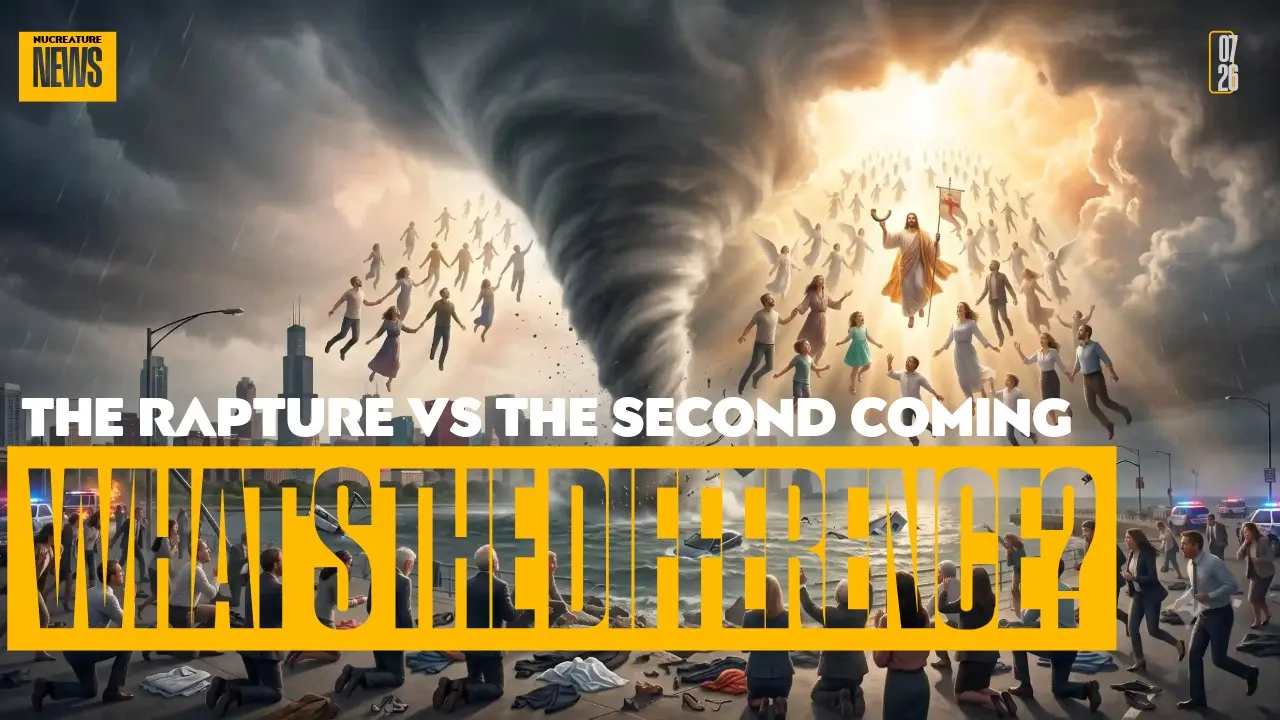
The Rapture and the Second Coming are related to Christ’s return, but they are not the same event according to the pre-tribulation interpretation examined in this article. The Rapture describes believers being caught up to meet Christ in the air, while the Second Coming describes Christ’s visible return to earth.
In fact there are many false teachings around that teach there will not be a rapture in the bible. But are they wrong when God has already “raptured” people in the past? I will also compare the Second Coming of Yeshua (Jesus) to understand the differences. Let’s examine the scriptures.
What Is the Rapture?
Hi I’m Philip Pearson, an ordained minister and prophecy student for over twenty years. I have been studying the bible since I was a young boy in elementary school.
I attended Evangelical Christian Academy on the Chicago’s south side. Attended church and bible study in grade school and at church on the weekends.
I first heard about the Rapture from my uncle Harold Gumm, an Apostolic preacher at my grandfather’s church (Shiloh Apostolic Church). I continued studying prophecy later in my adult life and currently attend Moody Bible Institute here in Chicago. A few of the prophecy teachers I learned from were Pastor John Hagee, Jack Van Impe, and Grant R. Jeffrey.
While both events involve the return of Jesus Christ, they differ in their timing and purpose. In this post, I will delve into the distinctions between the Rapture and the Second Coming of Christ, drawing upon pertinent biblical passages and exploring various theological interpretations.
What Is the Second Coming?
To truly understand the second coming vs rapture we must look directly at the text. Here is how the two distinct phases of Messiah’s return line up when backed by the explicit testimony of scripture, utilizing the Complete Jewish Bible (CJB).
| Prophetic Dimension | The Rapture (The Rescue) | The Second Coming (The Reign) |
| The Direction of the Saints | Messiah returns for His set-apart people. 👉 “Then we who are left still alive will be caught up with them in the clouds to meet the Lord in the air…” — 1 Thessalonians 4:17 | Messiah returns with His set-apart people. 👉 “And Adonai my God will come to you, with all the holy ones with him.” — Zechariah 14:5 |
| The Earthly Footprint | Messiah does not descend to the physical earth; the meeting happens in the atmosphere. 👉 “…to meet the Lord in the air; and thus we will always be with the Lord.” — 1 Thessalonians 4:17 | Messiah will descend physically onto the earth to establish His literal, visible kingdom. 👉 “On that day his feet will stand on the Mount of Olives, which faces Yerushalayim on the east…” — Zechariah 14:4 |
| The Prophetic Timing | Imminent and unannounced; it can occur at any moment with zero mandatory signs. 👉 “But of that day and hour no one knows… Watch therefore, for you do not know what hour your Lord is coming.” — Matthew 24:36, 42 | Calculated and visible; it occurs at the climax of judgment, seven years after the covenant timeline begins. 👉 “Immediately after the tribulation of those days… they will see the Son of Man coming on the clouds of heaven with power and great glory.” — Matthew 24:29-30 |
The Structural Core: The Rapture is characterized by an evacuation of the bride before wrath (1 Thessalonians 5:9), while the Second Coming is characterized by an invasion to execute judgment and claim the throne (Revelation 19:11-16). Understanding the text requires keeping these two paths structurally separate.
Difference Between the Rapture and the Second Coming Concept
The concept of the Rapture and the Second Coming of Christ are two significant events in Christian eschatology (study of prophecy). This biblical concept is described in 1 Thessalonians 4:13-18 and 1 Corinthians 15:50-54.
Timing of the Rapture:
The Rapture is often associated with the pre-tribulation rapture, which means that believers will be taken up to meet Christ before a period of tribulation on earth.
This view is based on passages such as 1 Thessalonians 4:16-17, which describes believers being caught up in the clouds to meet the Lord. On the other hand, the Second Coming of Christ is believed to occur after the tribulation period. (Matthew 24:29-31; Revelation 19:11-16) This view suggests that Christ will return to earth to establish His kingdom and judge the nations.
Purpose of the Rapture:
The purpose of the “Blessed Hope” is to deliver believers from the wrath and judgment that will come upon the earth during the tribulation period. It is seen as a means of rescue and escape for believers, as they are taken up to be with Christ.
The Second Coming, on the other hand, is associated with the establishment of Christ’s kingdom on earth. It is a time of judgment and restoration, where Christ will reign as King and bring about the fulfillment of God’s promises.
Implications for Believers:
The belief in the Rapture has implications for believers in terms of their hope and readiness. It encourages believers to live in anticipation of Christ’s return and to be prepared to meet Him in person.
The Second Coming, on the other hand, emphasizes the need for believers to endure and persevere through seven years of hell on earth. It calls believers to remain faithful and to actively participate in God’s work in the world.
Conclusion:
The Rapture and the Second Coming of Yeshua are two distinct events in Christian eschatology. The Rapture is an event where believers are taken up to meet the Messiah before a period of tribulation. The Second Coming refers to Christ’s return to earth after the tribulation to establish His kingdom.
There are some who argue the Tribulation period will begin before the Rapture. However, the Bible says that “there is therefore now no condemnation to those who are in Christ Jesus” (Romans 8:1), which suggests the Church will not experience God’s judgment during the Tribulation.
Has God Raptured Before? The Case of Eliyahu (Elijah)

The Prophet Eliyahu (Elijah) “Raptured” In A Tornado.
The sudden departure of the prophet Eliyahu (Elijah) stands as one of the most dramatic, supernatural events in the entire biblical narrative.
Just as the Rapture represents a sudden catching away of believers into the atmosphere, Eliyahu’s exit serves as a powerful Old Testament picture of an individual being translated directly to heaven without experiencing physical death.
The account is recorded vividly in Melakhim Bet (2 Kings) Chapter 2, using the text of the Complete Jewish Bible (CJB) to preserve the depth of the Hebrew narrative.
The Dynamic Departure at Jordan
As Eliyahu and his successor, Elisha (Elisha), walked together across the dry bed of the split Jordan River, their conversation was abruptly interrupted by a manifestation of heaven’s raw power.
The text captures the exact moment the separation occurred:
“As they kept walking and talking, suddenly there appeared a chariot of fire with horses of fire, which separated the two of them; and Eliyahu went up by a whirlwind into heaven.” — 2 Melakhim (2 Kings) 2:11 (CJB)
The Rapture of Eliyahu (Elijah): The Chariot vs. The Whirlwind
A common misconception in casual reading is that Eliyahu rode away inside the fiery chariot. However, a precise reading of the text reveals a different mechanic:
- The Chariot and Horses of Fire: These acted as a divine barrier, physically cutting in between the two men to separate them.
- The Whirlwind: It was actually the whirlwind (se’arah) that caught Eliyahu up vertically into the heavens, completely bypassing death.
Sources






You must be logged in to post a comment.