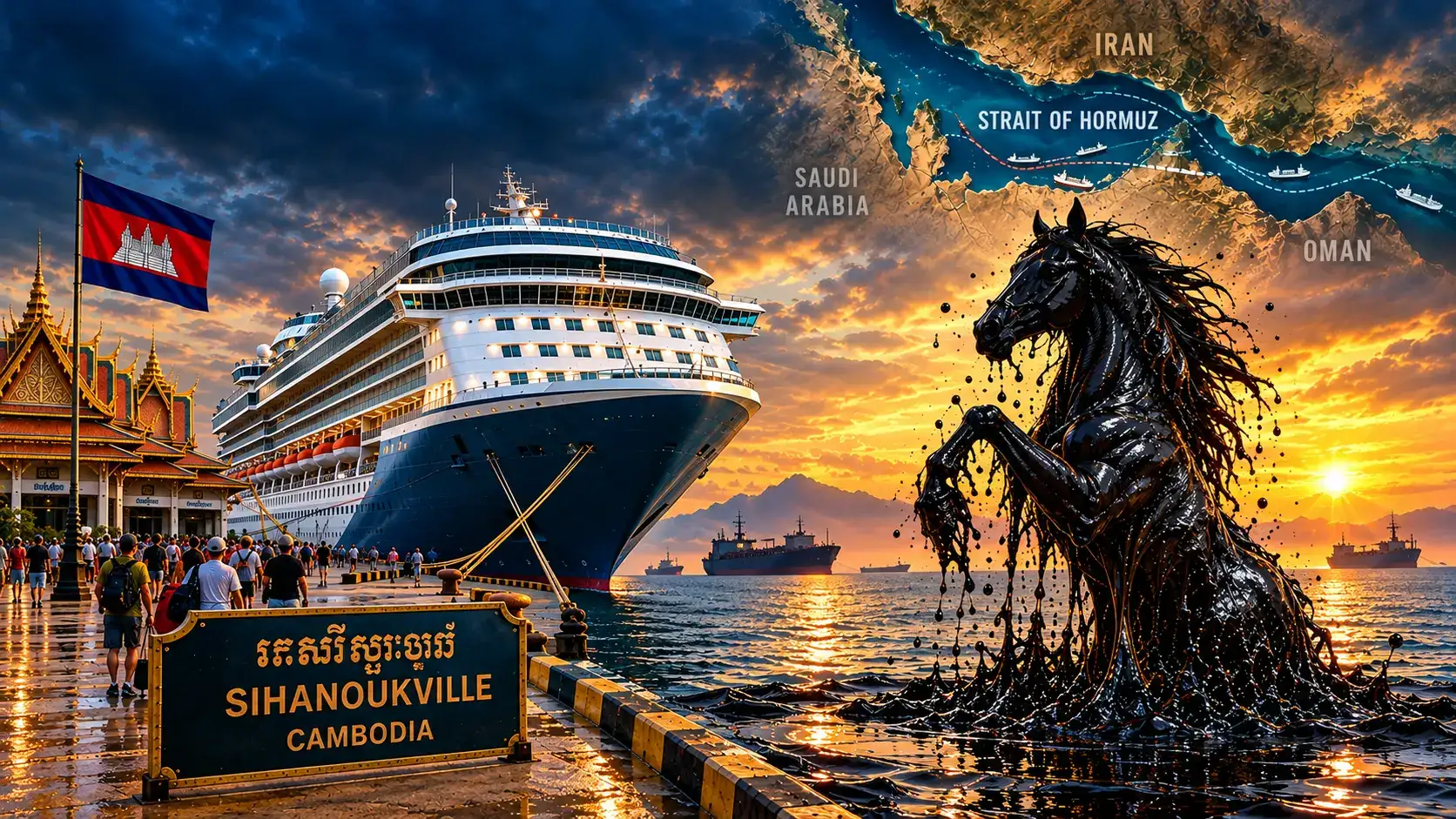
Wow, a cruise ship stranded in Cambodia is the latest result of the rise of “Black Horse Economy” described in Revelation 6.
MV Odyssey Cruise Ship Stranded
The Odyssey was not selling a typical holiday. It was selling permanence. Residents bought cabins as homes and signed up for a life organized around continuous global movement: ports, passports, itineraries, and the promise that the world would remain accessible.
Then fuel stopped being an affordable operating expense.
The vessel’s operator said monthly fuel costs per cabin, historically about $1,800, had risen to an estimated $6,000 to $8,000 in parts of Asia amid disruption connected to the Strait of Hormuz crisis. The company suspended the voyage in Sihanoukville, Cambodia, and began arranging for passengers to disembark.
Cruise Ship Stranded: The Black Horse Economy?
That is the Black Horse Economy in one image: people carrying luggage off a ship that was supposed to be their home.
We are familiar with the idea of a “black swan”: an unlikely event that surprises markets and institutions.
But the Black Horse Economy is different.
It is the economy created by visible risks that institutions acknowledge but fail to price properly. The risks are in plain sight—chokepoints, dependence on cheap fuel, overstretched supply chains, fragile financing—but they remain abstract until one event makes them personal.
The Strait of Hormuz has always been more than a narrow waterway. It is a strategic pressure point in the global energy system. When traffic through it is disrupted or constrained, the consequences do not remain in the Gulf.
They show up in freight rates. Insurance costs. Airline tickets. Food prices. Manufacturing margins. Utility bills.
And, apparently, in whether a ship can afford to keep sailing.
The Odyssey is not an outlier because it was vulnerable. It is an outlier because its vulnerability became visible.
When mobility becomes a stranded asset
For decades, globalization taught us to treat movement as a given.
Goods would arrive. Ships would sail. Flights would depart. Fuel would be available. The systems underneath modern life were assumed to be stable enough to fade into the background.
That assumption is now expensive.
The passengers of the Odyssey were sold a version of mobility as security: a permanent home that could move away from uncertainty. Yet the model depended on the same systems it seemed to transcend—reliable fuel supply, predictable routes, affordable operating costs, and a company capable of absorbing shocks.
When those conditions changed, the home became an asset that could not move.
That is the deeper economic lesson. In a volatile world, a thing is not secure simply because it is valuable. It is secure only if the systems required to operate, maintain, move, insure, or finance it remain intact.
A ship can be a home—until fuel prices make it a docked liability.
The real cost of geopolitical risk
The usual language of geopolitical tension can feel remote: shipping lanes, deterrence, sanctions, escalation, energy security.
But those phrases conceal the human chain reaction.
A disruption in the Strait of Hormuz can mean a higher fuel bill in Southeast Asia. That higher bill can break the operating model of a residential cruise. That collapse can force people to find housing in a country they did not plan to live in.
This is why the price of geopolitical instability cannot be measured only in barrels, percentages, or stock-market movement.
Its real cost is paid in disrupted plans.
It is paid by the company that cannot absorb another month of losses. By the worker whose employer passes along transportation costs. By the family whose groceries cost more. By the traveler whose route disappears. By the resident whose “forever home” becomes temporary accommodation on land.
The line between macroeconomics and personal life is much shorter than we like to believe.
The question investors, businesses, and households should ask
The MV Odyssey did not fail because people stopped wanting to travel.
It ran into a harder truth: desire does not eliminate dependency.
Every business model has a Strait of Hormuz—a dependency so essential that, if disrupted, it turns confidence into fragility. It may be fuel. It may be a single supplier, a shipping lane, cheap credit, a cloud provider, a labor market, or a political assumption.
The question is no longer, “Could this risk happen?”
The better question is: “What happens to us when it does?”
That is the rise of the Black Horse Economy.
It is not defined by one catastrophe. It is defined by the compounding effect of shocks that were once treated as background noise—and by the moment those shocks finally arrive at someone’s front door.
Or, in this case, their cabin door.
What part of everyday life do you think depends most on a global system we take for granted?
Source: The reported suspension, passenger count, and fuel-cost figures are based on Associated Press reporting.
