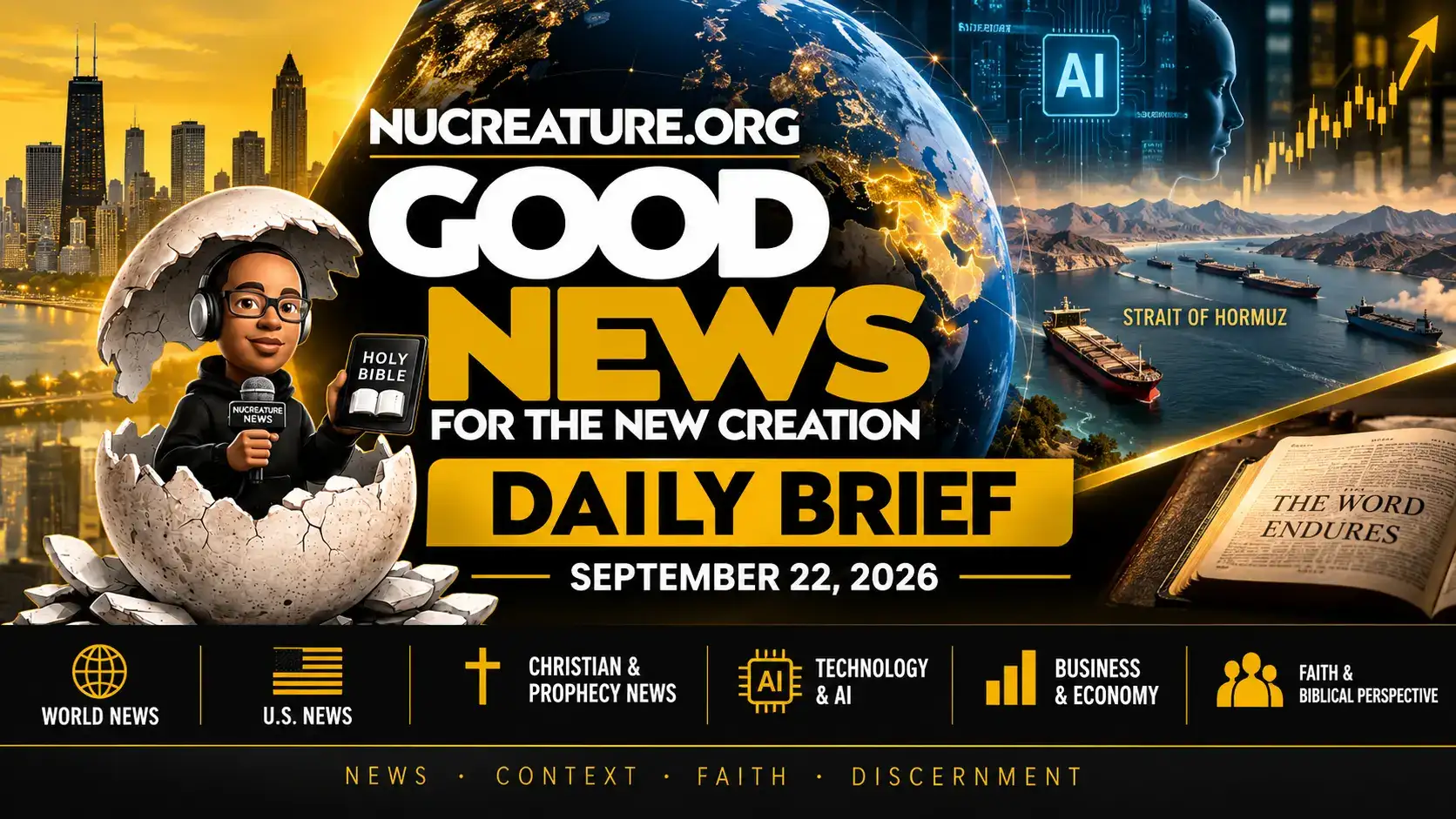
🌍 Today’s NuCreature Daily Brief
Iran, Strait of Hormuz, AI & World News: welcome to the NuCreature Daily Brief, bringing together the major stories shaping the United States, the world, technology, business, and the Christian community.
Today, attention remains heavily focused on the Middle East and the Strait of Hormuz, while U.S.-China relations and artificial intelligence are also emerging as major international issues.
As always, facts first. Biblical perspective second.
Iran, Strait of Hormuz, AI & World News: Iran Signals Possible Opening of the Strait of Hormuz
Iran has indicated that it could reopen the strategically important Strait of Hormuz within seven days if the United States eases military pressure and lifts its blockade on Iranian ports, according to a senior Iranian official who spoke with Reuters. Iran’s proposal was reportedly delivered to Washington through mediators on September 16.
The development comes as President Donald Trump addresses the United Nations General Assembly. Reuters reports that Trump called for the complete economic isolation of Iran, while also saying he expects an eventual agreement after the U.S. midterm elections. Secretary of State Marco Rubio has separately indicated that Washington remains open to dialogue if it could produce a constructive outcome.
Iran, Strait of Hormuz, AI & World News: Why the Strait of Hormuz matters
The Strait is one of the world’s most important energy chokepoints. Before the current conflict, approximately 125 large commercial vessels crossed the waterway each day, carrying roughly one-fifth of the world’s daily crude oil and LNG supply.
Preliminary shipping data showed only two commodity vessels crossed the Strait on Monday, compared with ten the previous day. Two vessels were also reported struck while transiting the waterway, although responsibility for those incidents remains unconfirmed.
🇺🇳 WORLD: France Considers UN Mission for Hormuz
France is working with the United States on a proposed United Nations Security Council resolution that would establish an international mission intended to safeguard commercial shipping through the Strait of Hormuz.
French officials say the proposal would focus on freedom of navigation and energy supplies while attempting to separate maritime security from the broader dispute with Iran. Previous efforts faced opposition from China and Russia, but French diplomats are exploring whether a new proposal could gain broader support.
What to watch: Whether France formally circulates the resolution and how the Security Council’s permanent members respond.
🇺🇸 U.S. & CHINA: AI, Trade and Taiwan
President Donald Trump and Chinese President Xi Jinping are preparing for meetings in Washington amid continuing disputes involving trade, artificial intelligence and Taiwan.
Reuters reports that Xi is expected to press Trump over U.S. arms sales to Taiwan, while Beijing continues to characterize the issue as central to the U.S.-China relationship. U.S. policy toward Taiwan remains shaped by American law and longstanding policy commitments.
The economic relationship is also closely tied to artificial intelligence.
Despite competition between the two countries over AI technology and supply chains, U.S. financial institutions and Chinese investors remain significantly connected to each other’s technology markets.
🤖 TECHNOLOGY & AI: The AI Trust Problem
Artificial intelligence is increasingly becoming a question not only of capability, but also trust.
A Gartner survey released September 22 found that 35% of U.S. consumers surveyed said they rely less on influencers for shopping information and recommendations because of the rise of AI-generated content. Gartner surveyed 1,006 U.S. consumers between May and June 2026.
The issue goes beyond influencers.
AI-generated images, videos, voices and text are making it increasingly difficult for people to determine what they can trust online.
Meanwhile, U.S. and Chinese officials are discussing a possible formal AI dialogue involving national-security concerns and notification of significant AI incidents.
NuCreature Perspective
The rapid development of AI makes discernment and truthfulness increasingly important.
Technology can change how information is produced.
It does not eliminate the responsibility to determine whether information is true.
💰 BUSINESS & ECONOMY: Oil Markets Watch Hormuz
Energy markets remain closely tied to developments in the Middle East.
Reuters reports that Saudi Arabia has restarted its East-West oil pipeline, which provides an alternative route for moving crude toward the Red Sea and away from the Strait of Hormuz.
The pipeline can ultimately handle approximately 7 million barrels per day, although sources say restoring full capacity could take several weeks because three pumping stations were damaged in an earlier drone attack.
The restart contributed to lower oil prices Tuesday, with Brent crude falling more than $2 per barrel toward $97.
For consumers, prolonged disruption to energy transportation can affect transportation, manufacturing, food distribution and other areas of the economy.
✝️ CHRISTIAN NEWS: Faith Amid Global Uncertainty
Christian communities continue to navigate conflict, persecution and political pressure around the world.
Christianity Today’s September 22 Daily Briefing highlights developments involving religious freedom, Christian communities and faith in public life, including reporting concerning Christians in the Middle East and other parts of the world.
Christian persecution also remains a significant global concern. Christianity Today’s reporting on the 2026 World Watch List cites increases in several categories of faith-related abuse and displacement, including cases involving Christians in Nigeria, Pakistan and India.
These stories deserve attention without reducing the experiences of individual Christians to statistics.
✝️ PROPHECY WATCH
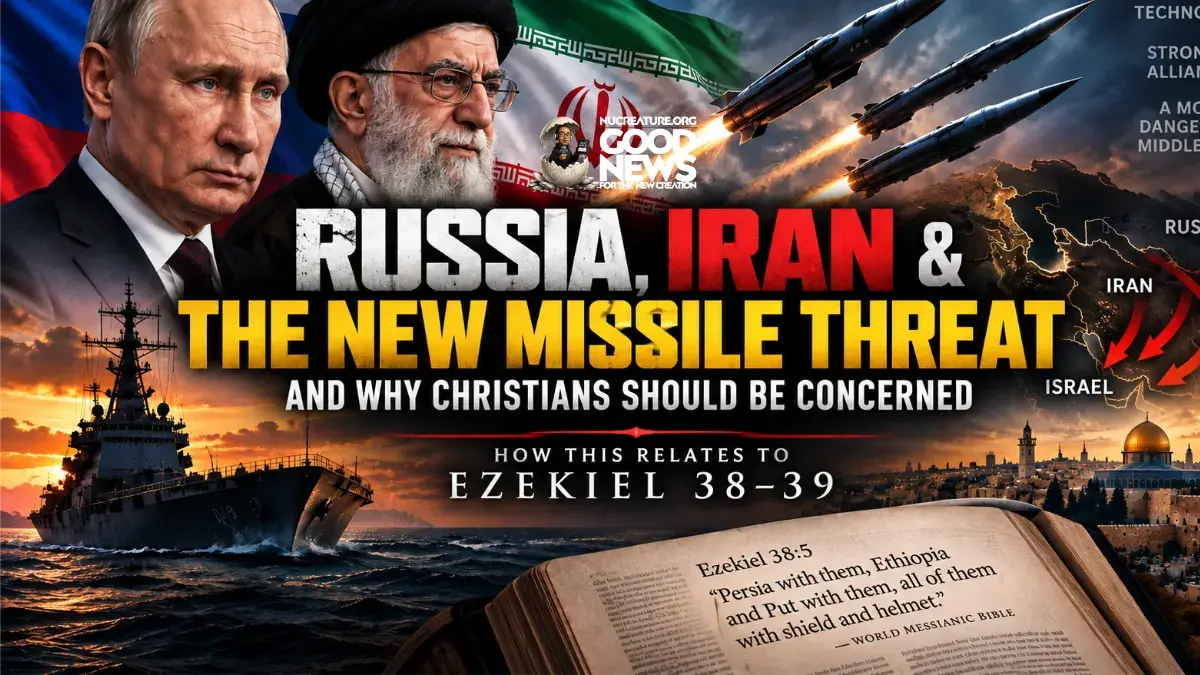
The Middle East naturally attracts considerable attention from Christians who study biblical prophecy.
Israel, Iran, Jerusalem, regional conflicts and international alliances can all raise questions about passages of Scripture concerning the last days.
But current events should not automatically be declared prophetic fulfillment.
The appropriate approach is to distinguish:
What happened
↓
What Scripture says
↓
What interpretation is possible
↓
What remains unknown
Jesus instructed His followers to remain watchful:
“Therefore keep watch, because you don’t know in what hour your Lord comes.”
— Matthew 24:42, WMB
Biblical watchfulness is ultimately about readiness and faithfulness, not predicting dates or forcing headlines into prophecy.
📖 VERSE OF THE DAY
“God is our refuge and strength, a very present help in trouble.”
— Psalm 46:1, WMB
When the headlines become overwhelming, Christians can remember that circumstances are not the foundation of their hope.
God is our refuge.
👀 WHAT TO WATCH
As September 22 continues, NuCreature News will be watching:
- 🇮🇷 U.S.-Iran diplomatic developments
- 🚢 Traffic and security in the Strait of Hormuz
- 🇺🇳 France’s proposed UN initiative concerning Hormuz
- 🇺🇸🇨🇳 Trump-Xi discussions
- 🤖 U.S.-China AI discussions
- 💰 Oil prices and global energy markets
- ✝️ Developments affecting Christians and religious freedom
- 🌍 Major developments involving Israel and the wider Middle East
📰 THE BIG PICTURE
Today’s headlines connect several major issues: war, energy, diplomacy, technology, artificial intelligence and religious freedom.
But the most important part of following the news isn’t simply knowing more headlines.
It’s learning to discern what is true, understand what is happening, and remain grounded in faith.
Sources:
Sources: Reuters, The National, United Nations.