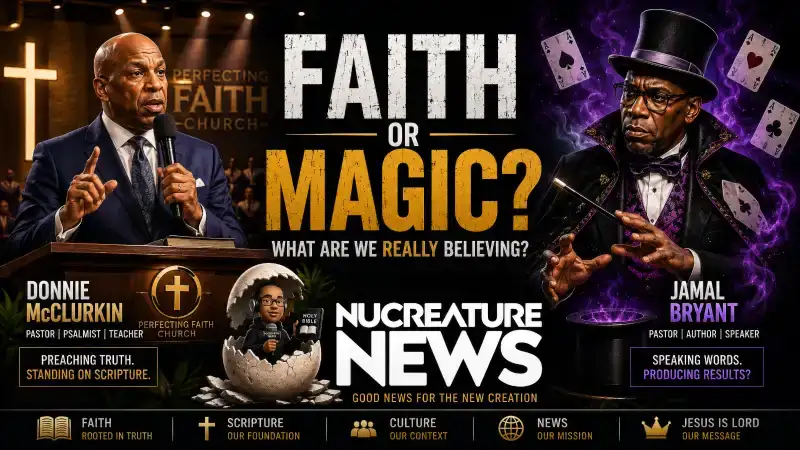
A recent video from Perfecting Faith Church featuring Pastor Donnie McClurkin has garnered significant attention on social media. In the video, McClurkin rebukes Pastor Jamal Bryant for using the magic incantation, “Abracadabra” in a sermon at New Birth.
Pastor Jamal Bryant claims that his church has the power to “call things into existence” by speaking this known witchcraft word into the air. The subject has quickly moved beyond a disagreement between prominent pastors because it raises a much larger question for Christians: Where does biblical faith end and spiritual self-empowerment begin?
In the video published by Perfecting Faith Church, McClurkin emphasizes a simple theological distinction: God is the Creator, while human beings are His creation.
The church’s accompanying message makes the point directly: “Only God can take nothing and turn it into something.” The post continues by emphasizing that this creative power is not something humanity was designed to possess independently of God.
That distinction is at the heart of the conversation.
Donnie McClurkin: What Does The Bible Say?
There is an important difference between believing that God responds to prayer and believing that human words possess an independent creative power.
Scripture certainly teaches that words matter. Words can encourage, destroy, deceive, restore, instruct, and influence the direction of people’s lives. Proverbs 18:21 famously says that “death and life are in the power of the tongue.”
But biblical Christianity does not teach that Christians become miniature creators who can command reality simply by speaking strongly enough.
The World Messianic Bible says in Romans 4:17 that God “calls things that are not, as though they were.” And that creative authority is only for God. Not us.
That matters.
Genesis presents creation as the work of God. “God said” appears repeatedly throughout the creation account, followed by the reality of what God commanded.
The biblical pattern is not humanity declaring reality into existence and God responding to our commands.
It is God speaking, God creating, and humanity responding to God.
The Real Issue Behind the Viral Clip
That is why the McClurkin video deserves more attention than simply becoming another social-media argument about which pastor is right.
Christian culture has increasingly adopted language involving “declaring,” “decreeing,” “manifesting,” and “speaking things into existence.” Some of these expressions can be used in legitimate biblical contexts, particularly when they refer to confessing God’s promises or verbally expressing faith.
The danger comes when the language begins to suggest that the believer’s words possess the same creative authority as God’s Word.
That changes the center of Christianity.
Instead of asking, “What is God’s will?”, the believer can begin asking, “How can I use spiritual principles to get what I want?”
Those questions may sound similar, but they represent radically different approaches to faith.
Biblical faith trusts God.
Biblical prayer seeks God.
Biblical obedience submits to God.
And biblical worship recognizes that God remains sovereign even when He does not give us the answer we expected.
“Only God Can Take Nothing and Make Something”
This may ultimately be the most important point in McClurkin’s message.
The Christian story itself begins with God creating what did not previously exist.
Human beings can rearrange materials. We can build businesses, compose music, design technology, write books, create art, and develop extraordinary inventions. But we create from materials, abilities, knowledge, and opportunities that ultimately exist because God allowed them to exist.
God’s creative authority is fundamentally different.
That distinction should produce humility rather than spiritual insecurity.
The Christian does not have to become a spiritual magician.
The Christian does not have to discover a secret formula.
The Christian does not have to find the perfect combination of words that forces heaven to respond.
Jesus taught His followers to pray, “May your Kingdom come. May your will be done, as in heaven, so on earth.”
That prayer places God’s will—not human control—at the center.
What About Speaking Life?
There is another side of this conversation that Christians should not ignore.
The Bible absolutely teaches believers to speak words of faith, hope, encouragement, truth, and blessing.
A person who continually speaks hopelessness over their own life can reinforce destructive thinking. A parent who constantly tells a child that they are worthless can cause profound emotional damage. A Christian who encourages someone with Scripture can help strengthen that person’s faith during an extremely difficult season.
Words matter.
But words matter because God created human beings to communicate, influence, teach, encourage, and respond to Him—not because human beings possess unlimited supernatural authority over reality.
There is a difference between saying, “I believe God can provide,” and saying, “I have the power to create provision by speaking it.”
There is a difference between saying, “I believe God can heal,” and saying, “My declaration guarantees the outcome.”
There is a difference between saying, “I trust God’s promises,” and saying, “My words determine reality.”
Those distinctions deserve careful attention.
Why This Belongs in Faith & Culture
This is exactly the kind of conversation that belongs in NuCreature News’ Faith & Culture coverage.
Faith does not exist in isolation from culture.
The words pastors use from pulpits eventually influence how millions of Christians understand prayer, money, success, suffering, healing, authority, and their relationship with God.
When a theological phrase becomes viral, Christians should not simply choose sides based on which personality they prefer.
We should go back to Scripture.
We should ask what the Bible actually teaches.
We should test popular Christian language against the character of God.
And we should be willing to correct ourselves when cultural Christianity begins drifting away from biblical Christianity.
The Bigger Question for Christians
The controversy surrounding “Abracadabra” may eventually disappear from social media.
The deeper question will remain.
Are we placing our faith in God—or are we being taught to place faith in our own ability to control outcomes?
Christian faith is not magic.
Prayer is not an incantation.
The Bible is not a collection of secret formulas for manipulating circumstances.
And believers are not called to become creators of their own reality.
We are called to trust the Creator.
As Romans 4:20-21 says in the World Messianic Bible, Abraham “was strong in faith, giving glory to God, and being fully assured that what he had promised, he was also able to perform.”
That is the biblical foundation worth recovering.
God speaks. God creates. God promises. God remains sovereign.
Our responsibility is not to become God.
Our responsibility is to trust Him.
Watch the Video
The discussion comes from an official Perfecting Faith Church post featuring Pastor Donnie McClurkin. The church’s official website also provides its live and sermon programming.
Watch the Facebook Reel from Perfecting Faith Church
Perfecting Faith Church — Official Live Page
NuCreature News Perspective
At NuCreature News, the goal is not simply to amplify controversy. It is to examine the moment through the lens of faith, Scripture, culture, and truth.
The question is bigger than Donnie McClurkin versus Jamal Bryant.
The question is whether modern Christian culture is teaching believers to trust God—or trust the power of their own declarations.
That is a conversation the Church cannot afford to avoid.
Good News for the New Creation.