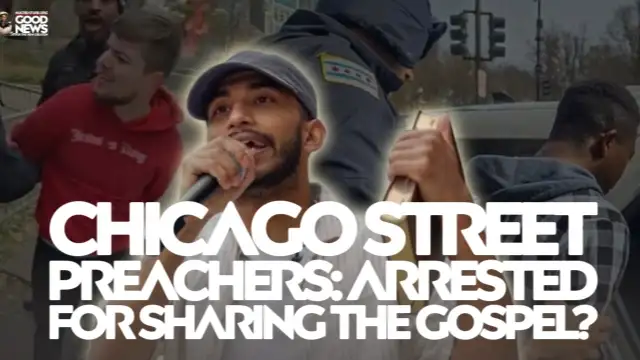
I can’t believe three Chicago street preachers were arrested by Chicago police while sharing the Gospel near Millennium Park. What began as a dispute over amplified sound has now grown into a federal civil rights lawsuit that raises serious questions about religious freedom and public preaching.
The case is still active in federal court, and a February 2026 ruling allowed several of the preachers’ constitutional claims to move forward. Here is what you need to know, and what the Bible says about it.
Chicago Street Preachers: What Happened?
The lawsuit was filed by Brett Raio, Perez Ndi, and Reetik Dhamala, three men who regularly share Christian messages in public spaces. According to the amended complaint, as summarized in the federal court’s February 24, 2026 opinion, the events took place near East Madison Street and North Michigan Avenue, close to Millennium Park.
On December 10, 2024, the men were preaching with a microphone and a battery-powered speaker. The complaint states that a passerby heckled them, and that the preachers moved their speaker farther away to avoid a confrontation.
Chicago police officers then arrived and questioned the men about their amplification and whether they had a permit. The situation escalated, Brett Raio was handcuffed, and officers threatened to handcuff Perez Ndi. The complaint describes this as interference with constitutionally protected religious expression.
The men later faced another arrest at the same location. According to their legal representatives, the criminal proceedings that followed were dismissed.
Chicago Street Preachers: Can the Government Limit Public Preaching?
The First Amendment protects both freedom of speech and the free exercise of religion. Those protections reach religious expression in traditional public forums such as sidewalks and public spaces, subject to lawful and fairly applied restrictions.
The heart of this case is not simply whether a city can regulate loud noise. It is whether police enforced those rules in a way that improperly restricted religious expression.
Chicago Municipal Code Section 8-32-070 regulates amplified sound on public ways, and it prohibits sound above average conversational levels at a distance of 100 feet or more from the source. The ordinance covers amplified communication and entertainment in general, not only religious preaching.
That distinction matters. A city may set reasonable rules for noise and public safety, but those rules cannot be used as a pretext to single out a particular religious message. The lawsuit alleges that officers selectively enforced the ordinance against the Christian preachers.
What the Federal Judge Decided
On February 24, 2026, U.S. District Judge Sara L. Ellis issued an opinion in Raio et al. v. City of Chicago, Case No. 1:25-cv-02709. She granted the city’s motion to dismiss in part and denied it in part.
Several important claims were allowed to move forward into discovery:
- First Amendment retaliation
- Free exercise of religion
- False arrest
- Retaliatory arrest
- Violations of the Illinois Religious Freedom Restoration Act
The court did dismiss the vagueness, equal protection, and free-speech-as-applied claims without prejudice. It is important to understand that this ruling is not a final decision that Chicago or its officers violated the Constitution. The court simply found that enough was alleged on several claims for the case to continue, and the remaining proceedings will help determine what actually happened.
Latest Update: Discovery Is Still Underway
The case has continued well past the February ruling. Court-related filings dated October 23, 2026 show ongoing discovery disputes as both sides work to obtain records and testimony.
The litigation includes questions about how officers enforced the amplification ordinance, what evidence was collected, and whether religious speakers were treated differently from other public speakers. The plaintiffs are also seeking information about the city’s broader enforcement practices.
The court’s schedule sets December 1, 2026 as the deadline for fact discovery, with a status hearing set for December 9, 2026. As of November 4, 2026, the case remains active.
What This Means for Christians Who Preach in Public
This case matters to pastors, evangelists, and everyday believers across the country. Public preaching is a form of religious expression, and Christians do not give up their constitutional rights simply because they share their faith outside a church building.
At the same time, constitutional protection does not automatically exempt anyone from every neutral noise, safety, or public-space rule. The key difference is between enforcing fair, neutral regulations and restricting someone because officials object to the message.
Believers who preach in public should understand their rights, stay peaceful, avoid blocking public access, and document interactions with law enforcement where it is legally permitted. The outcome of this case may offer further guidance on how religious expression and local enforcement fit together.
ACLJ or ACLU? Which Organization Is Involved
These two organizations are often confused, but they are separate. The American Center for Law and Justice (ACLJ) represents the three Chicago preachers in this lawsuit, and the American Civil Liberties Union (ACLU) is not the organization bringing this case.
What Does the Bible Say About Preaching the Gospel?
Beyond the legal questions, this story invites every believer to ask what Scripture says about proclaiming the Good News in public. Jesus gave His followers a clear commission.
He said to them, “Go into all the world and preach the Good News to the whole creation.”
Mark 16:15 (WMB)
When the apostles were ordered to stop teaching in the name of Jesus, Peter gave an answer that believers have returned to for centuries.
But Peter and the apostles answered, “We must obey God rather than men.”
Acts 5:29 (WMB)
These passages show that our faith was never meant to stay inside church walls. Believers have shared the Gospel in marketplaces, public squares, streets, and neighborhoods from the very beginning. Scripture also calls us to do it with wisdom, patience, and respect for others.
Preach the word. Be urgent in season and out of season. Reprove, rebuke, and exhort with all patience and teaching.
2 Timothy 4:2 (WMB)
Why This Case Deserves Your Attention
The Chicago arrests are about more than a microphone or a noise ordinance. They ask how government balances public order with the freedom to practice and express religious belief.
The lawsuit has not reached a final judgment, but the court’s decision to let several constitutional claims proceed makes it a significant religious liberty case to follow. For churches, pastors, and evangelists, it is a reminder to understand both the protections we have and the legal limits that apply to public gatherings.
NuCreature News & Media will keep following this case as it develops.
Sources and Further Reading
- U.S. District Court Opinion, Raio et al. v. City of Chicago (February 24, 2026)
- Chicago Municipal Code, Section 8-32-070: Music and Amplified Sound
- ACLJ: Preachers Arrested on the Streets of Chicago
- Raio v. City of Chicago: Federal Case Docket and Updates
- October 23, 2026 Court Filing and Discovery Exhibits
Editorial note: The court’s opinion summarizes allegations from the plaintiffs’ amended complaint, and those allegations are not all established facts. The ACLJ represents the plaintiffs, so its descriptions of the arrests reflect the position of their legal representatives.
