Iran and Oman discuss a temporary shipping corridor in the Strait of Hormuz as US pressure continues.
At the same time, commercial traffic through the waterway remains severely restricted. US Navy cleared mines from the shipping channel near Oman.
These developments create a complicated picture in which diplomatic progress and geopolitical confrontation are happening simultaneously.
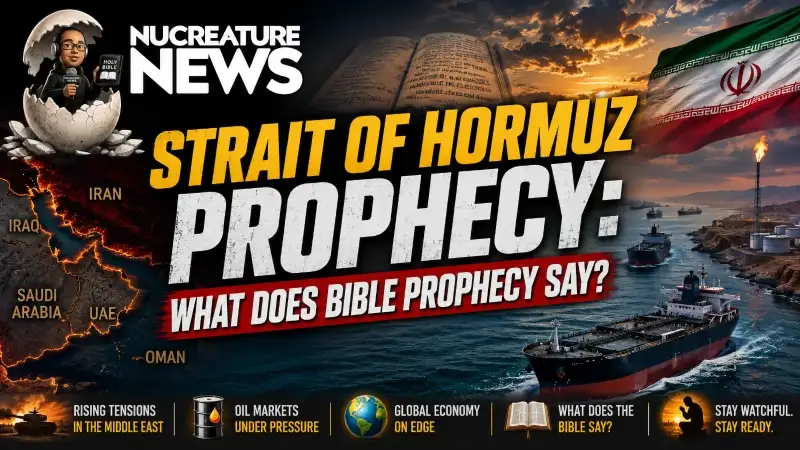
Strait of Hormuz Prophecy: A Turning Point?
For Christians watching these events through the lens of Scripture, an important question naturally follows: Could the Strait of Hormuz crisis become a prophetic turning point?
The answer requires biblical discernment rather than sensationalism. The Bible does not specifically identify the Strait of Hormuz as an end-times prophecy, but the events surrounding this strategic waterway deserve serious attention because they involve war, nations, economic pressure and the stability of the Middle East.
What Is Happening in the Strait of Hormuz?
The Strait of Hormuz connects the Persian Gulf with the Gulf of Oman and the Arabian Sea. Before the current conflict, the waterway carried roughly one-fifth of global oil and liquefied natural gas shipments, making it one of the most important energy chokepoints in the world.
That traffic has now fallen dramatically. Argus reported that only four vessels entered the Strait on August 24 and that no vessels exited during the following 24-hour period, putting traffic at roughly 3% of pre-war levels.
The consequences extend far beyond the Middle East. When a major energy route becomes difficult or dangerous to navigate, transportation costs, fuel markets, manufacturing and household expenses can all be affected.
A regional conflict can therefore become a global economic problem remarkably quickly.
Strait of Hormuz Prophecy: Why Christians Are Watching
The phrase Strait of Hormuz prophecy is attracting attention because the current crisis brings together several subjects frequently discussed in biblical-prophecy studies.
Those subjects include war, international conflict, economic instability, Israel, Iran, the Middle East and the possibility of broader geopolitical escalation.
However, Christians need to make an important distinction before drawing prophetic conclusions. Scripture does not mention the Strait of Hormuz by name, and there is no biblical passage that directly identifies today’s shipping crisis as the fulfillment of a specific end-times prophecy.
That means we should not claim that Revelation, Daniel or Matthew 24 specifically predicted this crisis.
Instead, we should examine what Scripture actually teaches and then consider whether today’s events provide meaningful context.
Iran and Oman Discuss a Temporary Corridor
One of the most significant developments on August 25 came from Iran and Oman.
The two countries discussed a phased framework that includes establishing a temporary joint navigational corridor through the Strait of Hormuz and working together on mine clearance. They also agreed that technical discussions would continue toward a permanent navigation corridor and future arrangements for managing the waterway.
Oman’s foreign minister said he was hopeful that the temporary corridor and practical arrangements for restoring safe navigation could be announced soon.
That is important because it creates a possible path toward reopening commercial traffic without requiring the entire U.S.-Iran dispute to be resolved first.
However, the discussions do not yet represent a complete settlement, and important questions remain about navigation, security, information sharing and future administration of the Strait.
For now, the proposed corridor should be viewed as a potential step toward de-escalation rather than proof that the crisis is over.
A Tanker Was Disabled Near Oman
While Iran and Oman were discussing safer navigation, a commercial tanker was disabled after being struck by an unidentified projectile near Oman’s coast.
The United Kingdom Maritime Trade Operations organization reported that the vessel was struck about nine nautical miles northeast of Ash Shishah, Oman.
The impact damaged the engine room and disabled the vessel, while the crew was reported safe. There was no immediate report of environmental damage.
The incident demonstrates why shipping companies remain cautious about returning to the Strait.
Diplomats may be discussing a temporary corridor, but commercial operators still have to consider whether vessels can safely move through the region.
That leaves the Strait caught between two very different forces: diplomatic efforts toward reopening and continuing security risks that discourage normal commercial traffic.
Trump Says the Strait Has Been Demined
President Trump announced August 25 that the U.S. Navy had removed or detonated mines from international waters in the Strait.
Trump also warned Iran that any vessel attempting to place new mines would face an immediate U.S. response. Two U.S. officials with direct knowledge of the operation separately confirmed that the Navy had cleared the main traffic separation scheme.
The announcement could make it easier for commercial vessels to move through the main shipping lane.
However, clearing mines does not automatically resolve every problem facing international shipping. Vessel operators must also consider attacks, military threats, insurance costs and the possibility that the political situation could deteriorate again.
Iran and Oman are separately discussing mine-clearing frameworks to restore safe navigation.
Strait of Hormuz Prophecy and the Global Economy
The economic consequences of the crisis may be one of the most important parts of this story.
The Strait is not simply a narrow waterway between Iran and Oman. It is a critical artery for the international energy system, and disruptions there can affect countries that are thousands of miles away.
When energy shipments are restricted, buyers must search for alternative supplies and transportation routes. That can create pressure on fuel prices and eventually affect transportation, manufacturing, agriculture and consumer goods.
This is why the economic dimension of the Strait of Hormuz prophecy discussion deserves careful attention.
Economic instability is not automatically proof that a biblical prophecy is being fulfilled. However, Scripture does describe a future period involving extraordinary economic pressure, which makes economic developments worth watching through a biblical lens.
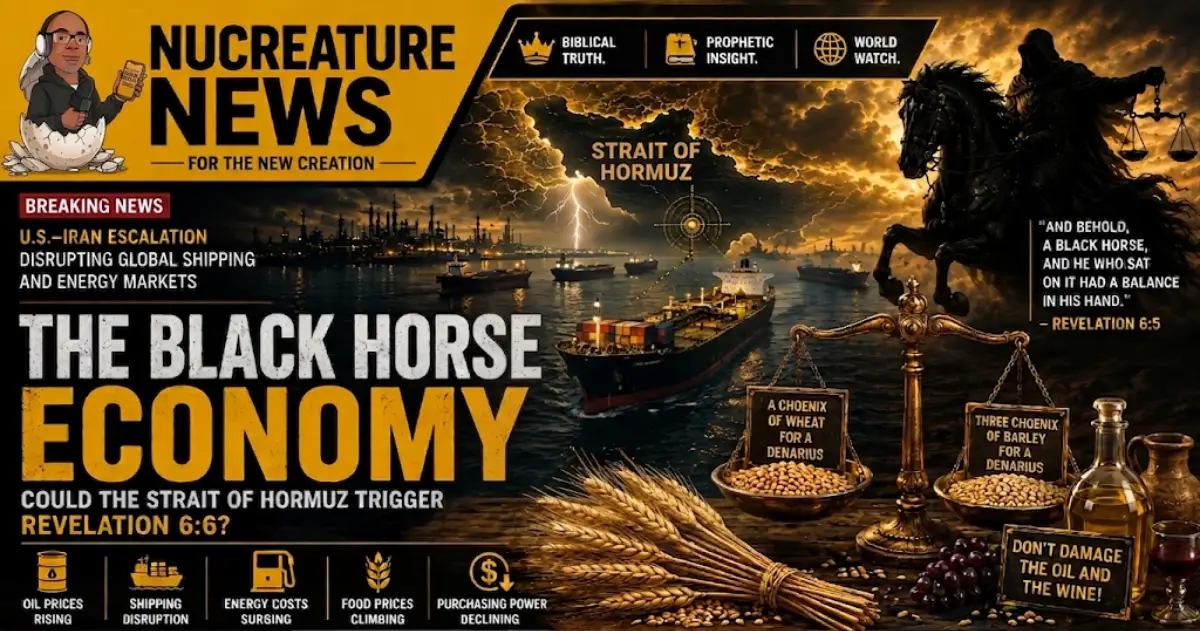
Strait of Hormuz Prophecy and the Black Horse
Revelation 6 describes the third horseman riding a black horse and carrying scales.
The passage describes a period when basic food commodities become extraordinarily expensive:
“A measure of wheat for a denarius, and three measures of barley for a denarius!” — Revelation 6:6, WMB
The current Strait of Hormuz crisis does not prove that the Black Horse of Revelation has arrived.
That conclusion would go beyond what Scripture actually tells us.
Nevertheless, the crisis provides a real-world example of how disruption to energy and transportation can create economic pressure across multiple countries.
That makes Revelation 6 worth studying without turning the passage into a prediction about today’s headlines.
What Does Matthew 24 Say About the Crisis?
Yeshua warned His disciples that the future would include wars and rumors of wars.
Matthew 24 describes nations rising against nations and kingdoms against kingdoms. Yet Yeshua also warned His followers not to become alarmed simply because these events occur.
The World Messianic Bible records His words:
“See that you aren’t alarmed, for all this must happen, but it isn’t the end yet.” — Matthew 24:6, WMB
That warning is especially important when discussing the Strait of Hormuz prophecy question.
Christians should pay attention to world events without allowing every headline to determine their theology.
Biblical watchfulness means remaining alert while carefully measuring our conclusions against Scripture.
Strait of Hormuz Prophecy Does Not Mean Date Setting
Recognizing prophetic themes is different from claiming that a specific prophecy has already been fulfilled.
Christians should therefore avoid announcing a date for the Rapture because of the Hormuz crisis or any other current event.
We should also be cautious about assigning modern nations specific prophetic identities unless the biblical evidence clearly supports such an interpretation.
Prophecy should produce discernment, faithfulness and hope.
It should not become an excuse for speculation or fear.
Why Israel Still Matters
The Hormuz crisis cannot be completely separated from the wider Middle East.
Iran and Israel remain central to the regional conflict, while the United States and Gulf nations have significant security interests connected to the outcome.
For that reason, developments involving Israel deserve continued attention from Christians studying prophecy.
Passages in Daniel, Ezekiel, Zechariah, Matthew 24 and Revelation should be studied carefully, but Christians should resist forcing every modern military or political event into a prophetic timeline.
Biblical prophecy is important enough to deserve careful interpretation.
Pakistan Is Trying to Revive Diplomacy
Pakistan has also become involved in efforts to restart negotiations between Iran and the United States.
Pakistani officials have described recent discussions with Iranian leaders as producing significant progress, while Iranian officials have indicated that Islamabad is helping communicate Tehran’s position to Washington. Reuters reported that Iran has signaled interest in reviving the political process, although major disagreements remain.
That diplomatic activity matters because the future of the Strait is connected to the broader U.S.-Iran confrontation.
A temporary shipping arrangement could improve navigation, but a lasting reopening may require a broader political settlement.
For now, diplomacy remains possible but uncertain.
Strait of Hormuz Prophecy: What Happens Next?
The next several days could be important because they may reveal whether the crisis is moving toward de-escalation or another escalation.
One major indicator will be whether commercial shipping begins returning to the Strait in meaningful numbers. Increased traffic would provide evidence that shipping companies believe the security situation is improving.
Another important question is whether Iran and Oman actually implement their proposed temporary corridor. The announcement is significant, but technical negotiations and security arrangements still have to be completed. citeturn0news0turn0search0
Christians should also watch whether attacks against commercial vessels stop. The tanker incident near Oman demonstrates that maritime security remains a serious concern even while diplomatic discussions continue. citeturn0search3turn0search4
Finally, developments involving U.S.-Iran negotiations, sanctions, Israel and the wider Middle East could quickly change the situation.
Is This a Prophetic Turning Point?
The Strait of Hormuz crisis may become a turning point, but we cannot know that with certainty today.
What we can say is that the crisis demonstrates how quickly a regional conflict can disrupt international shipping, energy markets and the global economy.
It also demonstrates how interconnected the nations have become.
A single maritime chokepoint can influence governments, businesses and families across the world.
That provides useful context when Christians study biblical passages concerning nations, economic hardship and the final period of human history.
Still, context is not the same as fulfillment.
The Strait of Hormuz crisis may eventually become part of a much larger historical development, but Scripture does not give us enough information to declare that today.
From a Biblical Perspective, This Changes Everything
The world is watching Hormuz because the Strait represents energy, commerce and geopolitical power.
Christians should watch for another reason.
Scripture reminds us that human kingdoms are temporary while God’s kingdom is eternal. Yeshua did not command His followers to predict every geopolitical development; He commanded them to remain faithful and ready.
That means Christians can follow the headlines without becoming controlled by them.
We can study prophecy without becoming obsessed with speculation, and we can recognize serious developments without claiming knowledge God has not given us.
Stay Rapture Ready
The most important response to the Strait of Hormuz prophecy question is not fear.
It is readiness.
Being rapture ready means trusting in Yeshua the Messiah, remaining faithful to His teaching and refusing to allow anxiety about world events to replace confidence in God.
Markets can rise and fall. Wars can begin and end. Governments can change their policies overnight.
But the believer’s hope remains anchored in Messiah.
Yeshua said:
“Therefore also be ready, for in an hour that you don’t expect him, the Son of Man will come.” — Matthew 24:44, WMB
That message remains relevant regardless of what happens in the Strait of Hormuz.
The Bottom Line
The Strait of Hormuz crisis is at a critical crossroads.
Iran and Oman are discussing a temporary navigational corridor and future arrangements for managing the waterway. At the same time, the United States says its Navy has cleared mines from the main international shipping lane. citeturn0news0turn0news20
Yet commercial traffic remains severely restricted, a tanker was recently disabled near Oman, and the broader U.S.-Iran dispute remains unresolved. citeturn0search5turn0search3
These events are serious and could have major consequences for the global economy and the future security of the Middle East.
But Christians should resist the temptation to declare that this crisis definitively fulfills a specific Bible prophecy.
Instead, we should remain watchful and discerning.
The world may be watching the Strait of Hormuz because of oil, shipping and geopolitics.
Christians should be watching for the return of the King.
Stay faithful. Stay awake. Stay rapture ready.
Sources
- Reuters — Iran and Oman discuss temporary Hormuz corridor as impasse with U.S. drags on. Reuters report
- Reuters — Iran vows to resist widened U.S. sanctions, says Washington seeks talks. Reuters report
- Associated Press — Iran and Oman hold talks on managing the Strait of Hormuz and other news from around the Middle East. Associated Press report
- Trump: Mines fully removed from Strait of Hormuz. Axios report
- Argus Media — Outbound Hormuz transits drop to zero. Argus Media report
- CBS News — Iran says it’s ready for new sanctions; updates on Strait negotiations. CBS News live coverage
- Critical Threats Project — Iran Update, August 25, 2026. Critical Threats analysis