
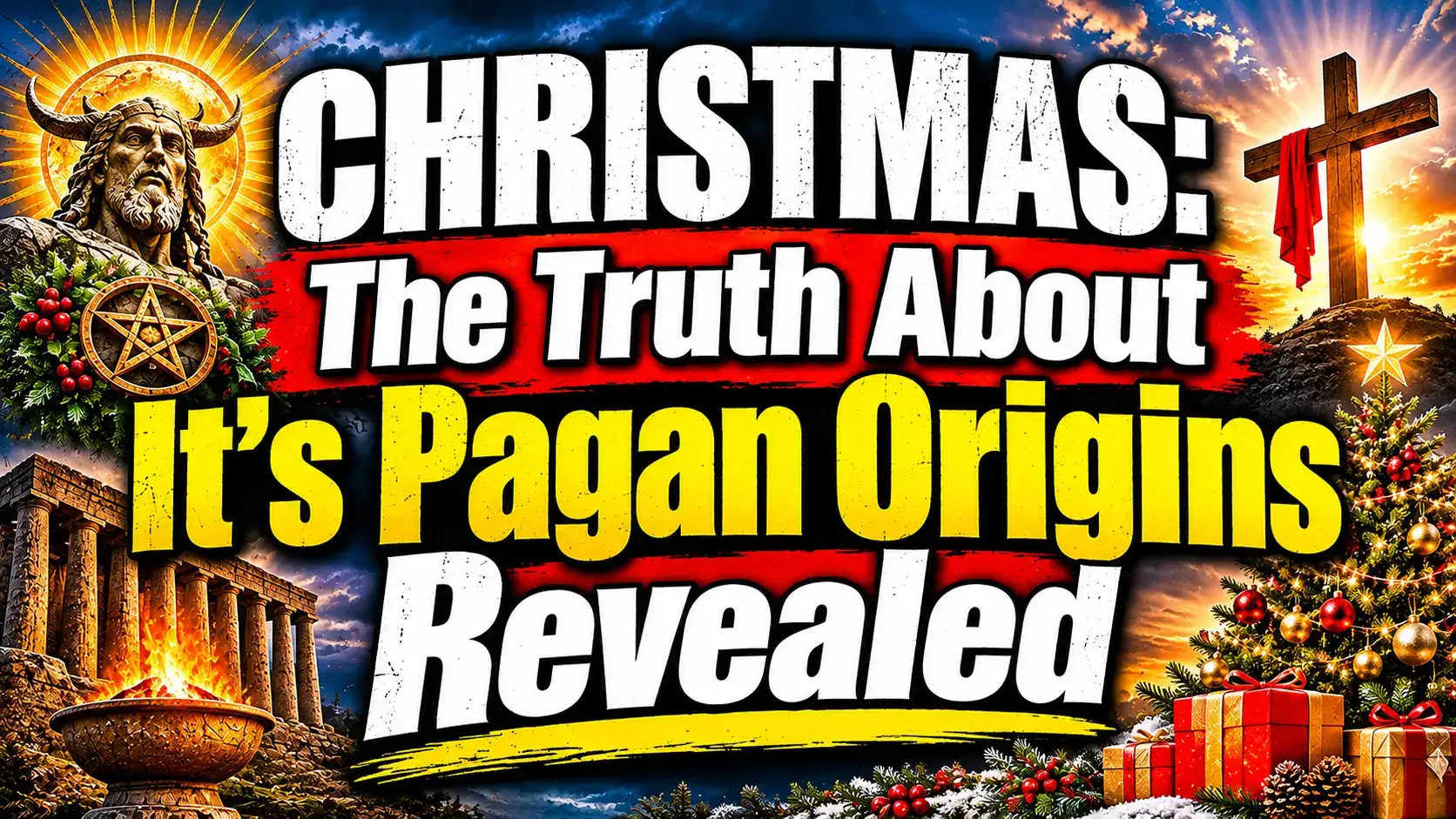
I got a question, Is Christmas a pagan holiday? December 25 isn’t found anywhere in Scripture. So where did it come from? Christian Holidays are ancient Pagan festivals that were ushered in by the Roman Catholic Church during the rule of Emperor Constantine.
Constantine was a Pagan follower of Mithra(s) who had what he thought was a “Christian experience” that led him to victory in battle. He wanted to unite his empire, both Christian and pagan together with a Universal (Catholic) religion.
Several Christmas traditions, such as decorating the tree, grew out of older Roman and Germanic pagan winter celebrations. I’ve researched this subject for years and found its pagan origins and God’s warnings to believers.
Christmas: Key Takeaways
- The Bible never states the day or hour of Yeshua’s birth.
- The earliest record of Christmas on December 25 comes from Rome in the fourth century.
- Saturnalia and the Roman festival of the Unconquered Sun fell near the same time of year.
- Scholars are divided on whether the date was borrowed or calculated.
- Scripture calls believers to worship Yahweh on His terms, and Paul urges conviction and charity over disputed days.
Christmas: Does the Bible Give a Date for the Birth of Yeshua?
No. Matthew and Luke describes the Messiah’s birth in Bethlehem. The shepherds and the visit of the magi, nor any of the Gospels gives a day, a month, or an instruction to celebrate it. The first believers kept the feasts of Israel.
The early church remembered the death and resurrection of Messiah. Not his birth. There is no sign in the New Testament that they held a birthday festival. In the third century, the Christian teacher Origen of Alexandria even wrote that Scripture shows only sinners such as Pharaoh and Herod marking birthdays.
When Did Christmas Start on December 25?
The earliest surviving evidence is a Roman calendar compiled in AD 354 that lists December 25 as the birth of Messiah, reflecting a celebration in Rome around AD 336. That is more than three centuries after the resurrection. Before then, believers in different regions marked the season in different ways, and the date of Yeshua’s birth was not settled.
What Were Saturnalia and the Festival of the Unconquered Sun?
Saturnalia, a Roman pagan festival honoring the god “Saturn” where they named the seventh day of the week, “Saturn-Day”. The day washeld in mid to late December, featured feasting, gift-giving, and a temporary reversal of social roles. In AD 274, Emperor Aurelian established Sol Invictus. It’s a festival of the Unconquered Sun, on December 25. Since both celebrations coincided with Christmas, many believe the Catholic Church adopted this pagan holiday.
Was the Date Borrowed or Calculated?
This is where the research gets interesting. There are two main explanations:
- The borrowing view: Church leaders chose December 25 to compete with, or absorb, popular Roman festivals. Writers who say this directly appear centuries later, in the Middle Ages.
- The calculation view: Some early Christian writers linked the conception of Messiah to March 25, the date they associated with His death, and counted nine months forward to December 25. Writers such as Tertullian and Hippolytus mention this kind of reasoning in the second and third centuries.
Many historians think both forces may have played a part. The safest statement is that the date is traditional and not biblical, and that its origin is still debated.
Where Did Christmas Traditions Come From?
- Yule: Germanic peoples held a midwinter festival called Yule, and traditions such as the Yule log and winter feasting later blended into Christmas customs in northern Europe.
- The Christmas tree: The decorated tree is documented in Germany in the 1500s. Bringing evergreens indoors in winter is a much older folk practice.
- Santa Claus: The figure grew from Saint Nicholas, a fourth-century bishop of Myra known for generosity, and was reshaped over the centuries by European and American folk culture.
- A caution on popular claims: Stories about ancient Druids and mistletoe are repeated widely online, but the evidence is thinner. It is better to cite what can be documented.
What Does the Bible Say Pagan Holidays?
Several passages shape how believers think about this question:
- Deuteronomy 12:29-32: Israel was warned not to ask how the nations served their gods and then copy their methods in worshipping Yahweh. Many believers cite this as a call to keep worship separate from pagan practice.
- Jeremiah 10:1-5: This passage is often connected to the Christmas tree. Many scholars read it as a description of carving idols from wood, so applying it to Christmas trees is an interpretation that believers disagree about.
- Romans 14:5-6: Paul speaks of those who honor a certain day and those who do not, and he asks each person to be fully convinced in their own mind and to act for the Lord.
- Colossians 2:16-17: Paul tells believers not to let others judge them over festivals or special days, because these are a shadow of what is to come, and the substance belongs to Messiah.
Some believers conclude that Christmas should be set aside. Others keep it with a clear focus on Yeshua. The text asks us to hold conviction with humility and not to condemn one another.
What About the Biblical Feasts?
Leviticus 23 lists the appointed times of Yahweh, including Passover, Shavuot, and Sukkot. Yeshua kept these feasts, and the Gospel of John also records Him at the Feast of Dedication, which we know as Hanukkah, in the winter (John 10:22). Some believers point to John 1:14, where the Word “tabernacled” among us, and suggest a birth near Sukkot. That is a view, not a proven fact, but it shows why many Messianic believers turn to the feasts to celebrate Messiah’s coming.
Did the Puritans Ban Christmas?
Yes. In 1647 the English Parliament banned Christmas celebrations, and from 1659 to 1681 Massachusetts fined people for observing it. The Puritans objected that it had no biblical basis and carried pagan baggage. The question is far from new.
How Can Believers Respond?
What you decide is between you and Yahweh. Whatever you choose, test it by Scripture, keep Yeshua at the center, and treat other believers with grace. Consider studying the feasts of Leviticus 23 this season, and use December to teach your family about the true Light of the world.
Frequently Asked Questions
Is Christmas a pagan holiday?
The date and several customs overlap with older pagan celebrations, but historians debate how direct the connection is. Christmas today is observed by many people as a celebration of the birth of Messiah.
Was Jesus born on December 25?
The Bible does not say. The date was set by tradition in the fourth century.
Does Jeremiah 10 forbid Christmas trees?
The passage describes idol making. Whether it applies to Christmas trees is a matter of interpretation.
What does the Bible say about celebrating holidays?
Scripture gives the feasts of Yahweh in Leviticus 23 and calls believers to follow conscience and charity on disputed days (Romans 14).
What You Need to Know
Reporting tells us where the customs came from. Interpretation asks what to do about it. The question for every believer is the same: what does this mean, and what does the Bible say? Subscribe to NuCreature News for more Bible study, prophecy, and Hebrew roots teaching delivered straight to your inbox.
