SEO Keyphrase: Black Horse Economy
Secondary Keywords: Strait of Hormuz, Revelation 6:6, Black Horse Revelation, biblical prophecy, oil crisis, food inflation, Iran, economic collapse
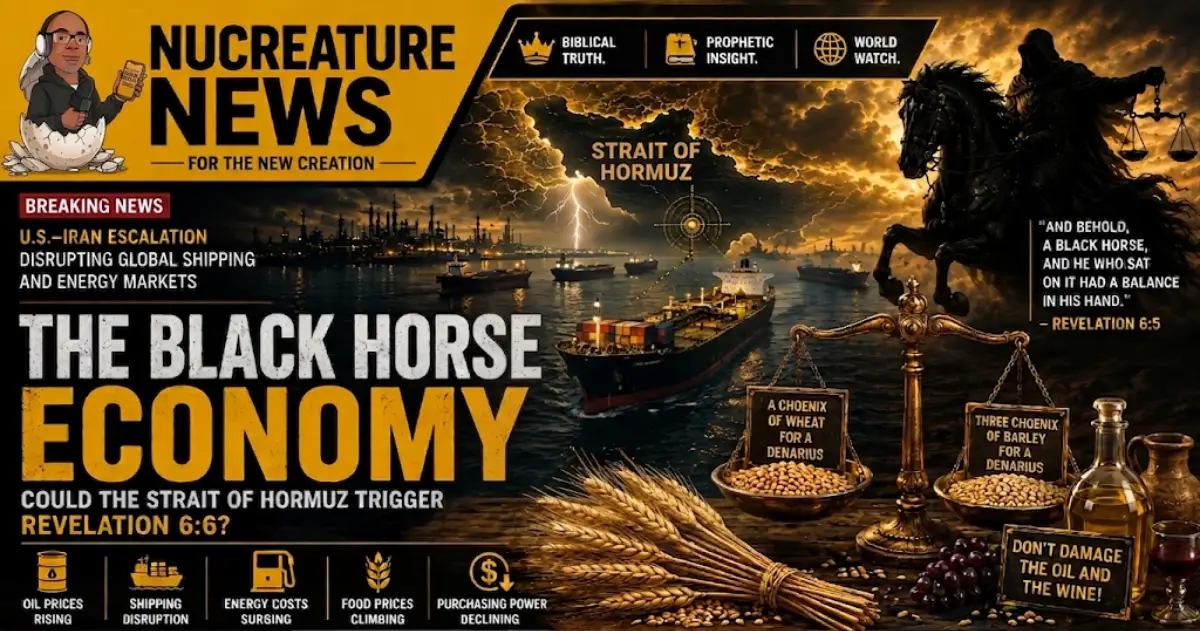
Could a prolonged Strait of Hormuz crisis become a catalyst for the Black Horse economy? In other words, economic conditions described and illustrated by the Black Horse of Revelation 6?
The Bible does not identify the Strait of Hormuz as the cause of the Black Horse economy. But scripture does, however, describe a remarkable economic environment in which food becomes extraordinarily expensive while oil and wine are specifically mentioned as being spared from damage.
The question is therefore worth examining—not as a claim that Revelation 6 is already being fulfilled, but as a potential economic pathway toward the type of conditions Revelation describes.
Black Horse Economy: What Does Revelation 6 in the Bible Actually Say?
When the Lamb opens the third seal, John sees a black horse whose rider carries a balance or scale.
The World Messianic Bible records:
“And behold, a black horse, and he who sat on it had a balance in his hand.”
Then comes the astonishing economic proclamation:
“A choenix of wheat for a denarius, and three choenix of barley for a denarius! Don’t damage the oil and the wine!” — Revelation 6:5–6, WMB
The imagery is fundamentally economic.
- There is a scale.
- There is measured food.
- There is a specified price.
- And there is a warning concerning oil and wine.
A common interpretation of the passage is that the Black Horse represents famine, scarcity, or severe economic distress, with staple foods becoming extraordinarily expensive. Commentary on the passage also connects the scale with rationing and food scarcity.
The crucial point is that Revelation does not merely describe “high prices.”
It describes an economy in which basic food consumes an extraordinary proportion of a person’s daily earning power.
Black Horse Economy: The Economics of Revelation 6:6
A denarius was associated with approximately a day’s wage in the first-century world. Revelation therefore presents a dramatic picture: a day’s labor purchasing only a very limited amount of staple food.
The WMB’s “choenix” refers to an ancient dry measure of volume, roughly a little more than a liter. Revelation describes one choenix of wheat for a denarius and three choenixes of barley for the same price.
In economic terms, the purchasing power of labor has collapsed. That distinction matters.
The Black Horse is not simply inflation. It is extreme inflation or scarcity affecting life’s necessities.
Black Horse Economy: Why Hormuz Matters
The Strait of Hormuz is not an ordinary shipping lane.It is a global energy chokepoint.
Reuters reports that approximately one-fifth of global oil supplies normally pass through the strait. Current traffic has fallen dramatically, with only five vessels transiting on Monday and no liquid tankers among them.
Two supertankers carrying Saudi crude were also struck while exiting the strait on Monday. Both vessels were carrying approximately two million barrels of crude.
Oil prices responded immediately.
Brent crude rose to approximately $92 per barrel, while U.S. West Texas Intermediate reached approximately $87.60 on September 1.
The significance goes far beyond gasoline.
Oil affects almost everything.
Transportation requires fuel.
Trucks move food.
Ships move fertilizer and agricultural commodities.
Factories consume energy.
Agriculture depends on fuel, chemicals and fertilizer.
Packaging, plastics and industrial materials depend heavily on energy.
Therefore, a sustained energy disruption can become a food-price problem.
The Potential “Black Horse” Chain Reaction
This is where the Hormuz hypothesis becomes particularly interesting.
Consider the potential chain:
Strait of Hormuz disruption
↓
Reduced oil and gas exports
↓
Higher crude prices
↓
Higher gasoline, diesel and transportation costs
↓
Higher fertilizer and agricultural-input costs
↓
Higher food-production costs
↓
Higher wholesale food prices
↓
Higher retail food prices
↓
Reduced purchasing power
↓
Food scarcity or rationing
↓
A potential “Black Horse economy.”
This is an economic hypothesis—not a prophecy claim.
But the mechanism itself is economically recognizable.
The European Central Bank recently concluded that the recent euro-area inflation increase associated with the Iran conflict was driven almost entirely by higher energy prices, illustrating how an energy shock can move rapidly into broader inflation.
The Most Interesting Detail: “Don’t Damage the Oil and the Wine”
This may be the most intriguing part of the entire Black Horse passage.
The voice does not simply say that everything becomes scarce.
It specifically says:
“Don’t damage the oil and the wine.”
Why?
There are several interpretations.
One interpretation sees oil and wine as commodities that remain relatively available while basic grain becomes scarce.
Another sees the passage as describing economic inequality, where necessities become prohibitively expensive while other goods remain accessible to those with greater resources.
Still another approach understands the oil and wine as literal commodities whose availability is protected during the crisis.
The text itself does not explicitly tell us which interpretation is correct.
That means NuCreature News should resist claiming that “oil” in Revelation 6:6 unquestionably means modern petroleum.
It may not.
Yet the coincidence is difficult to ignore:
A modern global economy becomes increasingly dependent upon an energy commodity whose disruption can directly affect food availability and prices.
Revelation describes an economic crisis in which staple foods become extraordinarily expensive while oil and wine are specifically protected.
That does not prove a prophetic connection.
But it makes the question worth investigating.
Why the Timing Is Interesting
Iranian oil exports have been severely disrupted.
Reuters reports that Iran has gone approximately seven weeks without meaningful crude exports through the Strait of Hormuz, an unprecedented disruption attributed to the U.S. naval blockade.
At the same time, global shipping through Hormuz remains far below normal levels.
The economic consequences are already visible.
The question is what happens next.
A short-lived disruption could produce a temporary oil-price spike.
A prolonged blockade could produce something much more consequential:
energy shortages → supply shortages → food inflation → rationing → destruction of purchasing power.
That second scenario begins to resemble the economic logic represented by the Black Horse.
But Are We Seeing Revelation 6 Fulfilled?
We cannot say that.
This is where responsible prophecy reporting matters.
There is currently no biblical statement saying:
“The Strait of Hormuz will trigger the Black Horse.”
There is also no verse identifying modern Iran, petroleum or the Persian Gulf as the mechanism that activates Revelation 6:5–6.
What we have is an observable modern crisis that could potentially produce economic conditions resembling the biblical description.
That is a hypothesis.
It should remain a hypothesis until the evidence becomes stronger.
FACT vs. INTERPRETATION
VERIFIED FACT
The Strait of Hormuz is experiencing severe shipping disruption.
VERIFIED FACT
Approximately one-fifth of global oil supplies normally pass through the strait.
VERIFIED FACT
Oil prices have risen in response to renewed U.S.-Iran hostilities and supply fears.
VERIFIED FACT
Iran’s crude exports through Hormuz have been severely curtailed.
VERIFIED BIBLICAL TEXT
Revelation 6:5–6 describes a black horse, scales, extremely expensive wheat and barley, and an instruction not to damage the oil and wine.
INTERPRETATION
A prolonged Hormuz energy crisis could contribute to the type of scarcity and purchasing-power collapse represented by the Black Horse.
The Bigger Question
Perhaps the most important question is not:
“Is Hormuz the Black Horse?”
The better question is:
“Could Hormuz be a catalyst that produces the kind of global economic conditions Scripture associates with the Black Horse?”
That question can actually be measured.
Watch the indicators.
Oil.
Diesel.
Fertilizer.
Wheat.
Barley.
Food prices.
Freight.
Wages.
Purchasing power.
Rationing.
If energy disruption remains prolonged, those indicators could reveal whether today’s geopolitical crisis is developing into something much more consequential.
What NuCreature News Should Watch Next
The next phase of this story should not be measured only by the price of crude.
Watch for food inflation accelerating faster than wages.
Watch for fertilizer shortages or price spikes.
Watch for shipping insurance and freight costs exploding.
Watch for government food-security measures or rationing.
Watch for wheat and barley prices responding disproportionately to energy costs.
And most importantly, watch the relationship between daily wages and the cost of staple food.
That last measurement gets closest to the economic imagery of Revelation 6:6.
Could the Black Horse Be an Economic Cascade?
The Bible describes the Third Seal in remarkably concrete economic terms.
A scale.
A measured quantity of food.
A day’s wage.
Scarcity.
Protected commodities.
It is therefore possible to investigate the passage not merely through symbolism, but through economics.
And today’s Hormuz crisis provides a real-world case study.
The Strait of Hormuz may not be the Black Horse.
But a prolonged disruption there could become a catalyst for exactly the kind of energy, food and purchasing-power crisis that makes the Black Horse imagery suddenly more understandable in a modern global economy.
That is the question worth watching.
And the answer may become clearer not through speculation—but through the numbers.
📖 Scripture Focus — Revelation 6:5–6 WMB
“And behold, a black horse, and he who sat on it had a balance in his hand. I heard a voice in the middle of the four living creatures saying, ‘A choenix of wheat for a denarius, and three choenix of barley for a denarius! Don’t damage the oil and the wine!’”